



.png)


Reimagining Maharashtra’s Rental Economy: A Blueprint for Equitable Urban Growth
A Dynamic Market Seeking Balance
Rents in Mumbai and Pune reflect the economic energy driving Maharashtra’s urban centres. For service workers, early-career technology professionals, and the broader workforce that sustains these cities, the housing ecosystem is undergoing rapid change. This transition offers a clear opportunity to strengthen formal rental pathways through responsive policy and institutional innovation.
Understanding Market Momentum
Residential rent growth across major metros, including Mumbai and Pune, has stabilized at 7–9 percent in the first half of 2025, easing from the steep post-pandemic increases seen between 2021 and 2024.
National rental yields stand at an average of 4.84 percent in Q2 2025, creating space for policies that make formal renting more appealing to both landlords and tenants.

In high-demand micro-markets close to employment hubs, the key challenge is converting economic activity into sustainable and accessible housing solutions—ensuring that growth and livability advance in tandem.
Maharashtra’s Digital Foundation
Maharashtra already leads the country in rental formalization.
Its e-registration platform allows for online drafting, e-stamping, Aadhaar-based execution, and digital storage of rental agreements.
This digital backbone reduces disputes, improves transparency, and provides a strong foundation for expanding formal rental systems.
The Maharashtra State Housing Policy 2025 further strengthens this direction. It emphasizes affordable rental housing for industrial and migrant workers through the PMAY-Urban ARHC framework, company-led worker housing, and MIDC-linked residential developments. While the framework is comprehensive, the next priority must be faster implementation and strategic site selection near key employment corridors.
Following Economic Growth Patterns
Pune’s office market highlights the state’s economic strength.
In the first half of 2025, net leasing reached 5.1 million sq. ft., marking a 17 percent year-on-year increase, driven by Global Capability Centers (GCCs) and flexible workspace providers. This growth across major corridors—Kharadi, Mundhwa, Balewadi, and Hinjewadi—signals sustained job creation and reinforces the need for housing in close proximity to workplaces.
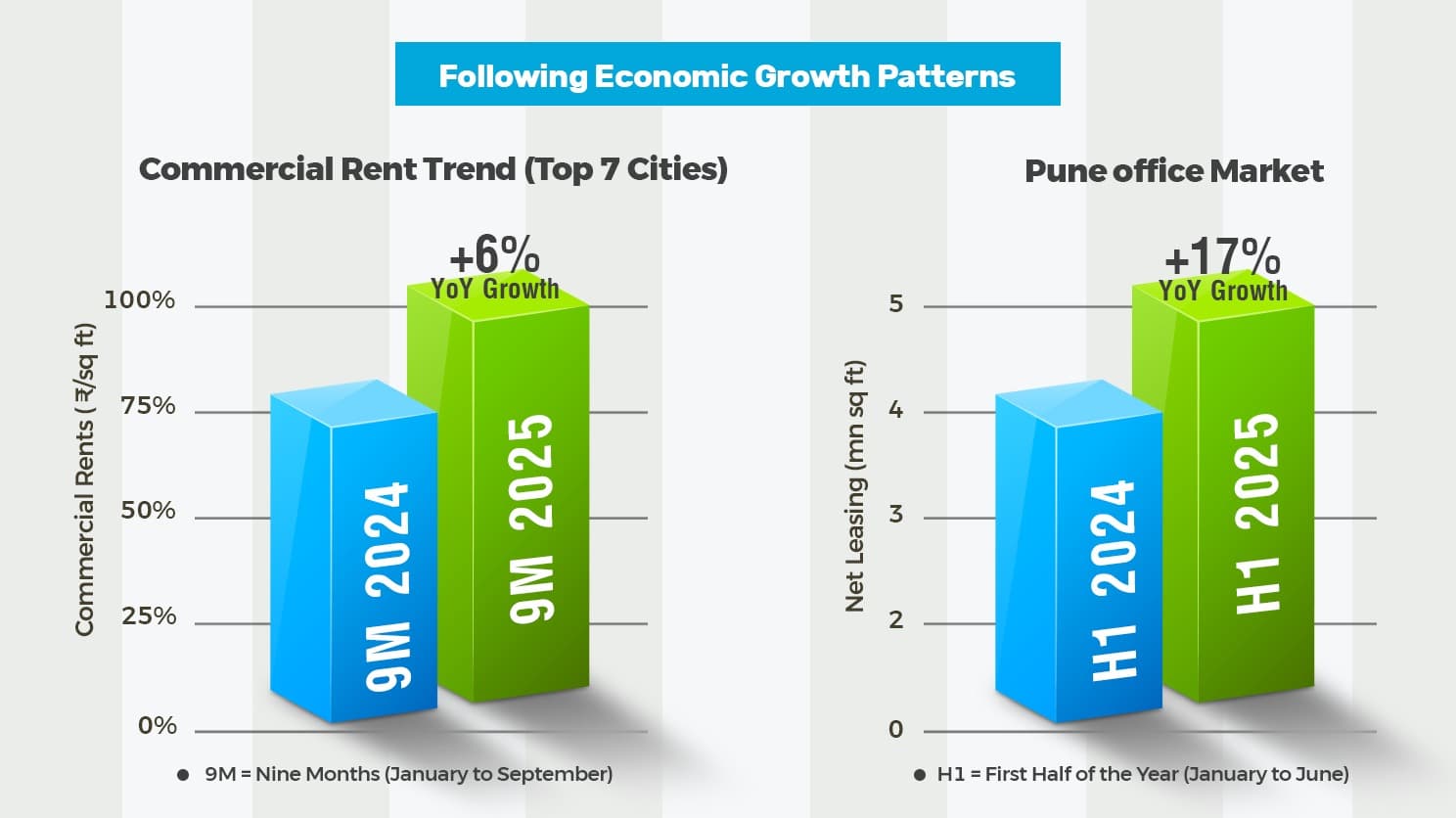
Across India’s top seven cities, commercial rents rose to ₹90 per sq ft by 9M 2025, a 6 percent increase from ₹85 in 9M 2024.
At the same time, Pune’s residential market continued to record strong sales momentum.
In Mumbai, ownership demand also remained steady, with June 2025 registrations crossing 11,200 units—the second-highest level in six years.
These trends reflect strong market confidence and capital availability.
The opportunity now lies in directing this momentum toward rental-focused development near employment hubs—balancing ownership aspirations with improved rental access.
Strategic Opportunities for Market Evolution
1. Supply Diversification
Developers can be incentivized to incorporate rental-dedicated segments within new projects through FSI benefits, faster approvals, and targeted tax incentives. Mixed-income and mixed-tenure developments can systematically enhance accessibility in well-connected locations.
2. Infrastructure Integration
Emerging corridors such as Wagholi, Phursungi, and Katraj present opportunities for coordinated transit and housing planning.
Aligning infrastructure expansion with residential growth can transform these areas from peripheral zones into fully integrated urban neighbourhoods.
3. Activation of Existing Stock
India has an estimated 11 million vacant urban homes, with a significant share in Maharashtra.
Supportive fiscal and procedural measures—such as reduced property tax for first-time rentals, simplified e-registration processes, and standardized lease agreements—can convert these underutilized assets into active rental supply.
To Read The Full Article: Visit Here