



.png)


Building the New Ownership Pathway: Renewing Middle-Class Housing Access

The Evolution of Aspiration
For generations, homeownership was primarily about security—a stable asset for future assurance. But for the ambitious youth arriving in Mumbai, India’s “City of Dreams,” that aspiration has transformed. A home is no longer merely a place to live; it is an entry point into the urban economy and a marker of personal success. This shift has been further accelerated by the post-COVID reality. The pandemic reshaped how we engage with our living spaces; today’s home must also function as a workplace, a space for wellness, and a safety net. Yet, this elevated expectation comes at a cost that average incomes can no longer sustain. In Mumbai, the pressure is visible in an EMI-to-income ratio of 48 percent—among the highest globally. While young professionals are ready to fuel the city’s growth, they are increasingly priced out, as costs surge while real incomes remain stagnant, gradually placing the ‘Mumbai Dream’ beyond the reach of middle-income families.
Aligning Growth with Accessibility
India’s cities continue to grow, driven by strong job creation and cross-sector investments. However, the simultaneous rise in property prices—with Mumbai recording a 7.5 percent annual increase—has intensified affordability challenges. This creates a spatial imbalance: as infrastructure strengthens urban cores, affordable housing shifts outward to the periphery. In Mumbai, the expansion of connectivity through Metro lines and the Coastal Road must be complemented by Transit-Oriented Development (TOD). At present, much of the middle-class workforce is compelled to exchange ‘quality of life’ for ‘affordability,’ enduring long commutes that diminish productivity. True accessibility lies in aligning housing density with transit networks, ensuring people can live within a reasonable distance of economic centers.
Reimagining Home Finance
After an extended phase of high interest rates, recent easing offers limited relief. However, lending patterns continue to favor luxury segments, often overlooking actual purchasing capacity. For middle-income households, the challenge is not only the cost of borrowing but also the inflexibility of access.
Conventional frameworks fall short for the ‘Missing Middle’—those who exceed eligibility for subsidies yet cannot meet the steep down-payment requirements of market-rate housing. Addressing this gap requires a more adaptive system that looks beyond static salary metrics. By introducing assisted down-payment models and evaluating cash-flow histories, access can be expanded to MSME owners and gig-economy professionals who are financially capable but lack formal documentation.
The Emerging Multi-Tenure Economy
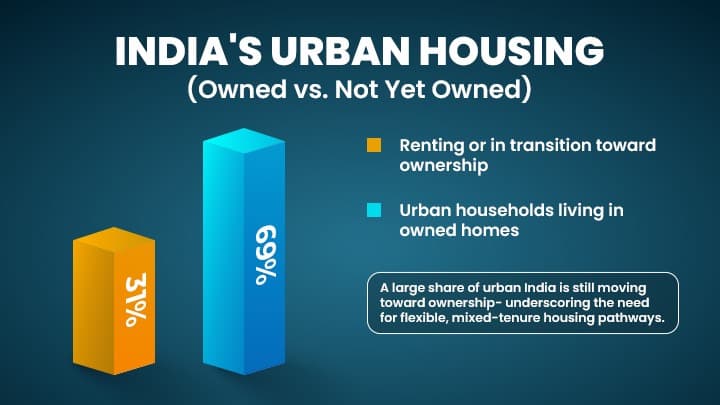
Urban India is steadily moving toward a multi-tenure housing model. While national homeownership remains high at 69 percent, patterns in metros like Mumbai are evolving. Greater mobility and income variability have encouraged more families to adopt flexible tenure options. However, the rental market remains largely fragmented and insecure, leaving non-owners exposed to uncertainty around tenure and deposit constraints.
To address this, policy must prioritize Institutional Rental Housing—large-scale, purpose-built developments managed professionally. By formalizing and standardizing the rental experience, it becomes possible to offer the stability of a home without the financial burden of ownership, transforming renting from a temporary compromise into a dignified, long-term choice.
Policy Innovation to Restore Access
Redefining “affordable housing” is essential to bridge the middle-income gap. Affordability should be linked to purchasing power, not just the size of an apartment. A 300 sq. ft. home cannot be considered affordable if it is priced at 15 times the median annual income. Housing prices, eligibility norms, and loan limits must reflect local realities rather than outdated benchmarks. Measures such as indexed caps, employer-assisted housing programs, and targeted interest subsidies can enhance purchasing power for mid-segment buyers.
Equally critical is improving market transparency. A unified listing platform for both rental and ownership housing can create a level playing field, reduce information asymmetry, and encourage competitive pricing—ultimately improving affordability. Alongside innovative approaches like land-lease models and shared equity structures, such measures can significantly reduce upfront ownership costs while ensuring equitable access across income groups.
To Read The Full Article: Visit Here